


What is a foundation slab?
It is a type of foundation that does not require deep excavation or extended drying times. The foundation slab provides a solid base for the future building. It is insulated from the ground across its entire surface using extruded polystyrene (XPS).
Reinforcement and concreting are also done over the entire area, unlike traditional foundations where footing trenches are made only along the perimeter of the building. In energy-efficient and passive construction, the foundation slab has become the standard.
Just like with traditional foundations, the function of the slab is to transfer the weight of the building to the ground. The foundation slab performs this task more effectively because the building’s weight is distributed across the entire surface of the slab, rather than linearly along the outer footings as is the case with traditional foundations.
Need a quote for a foundation slab for your project?
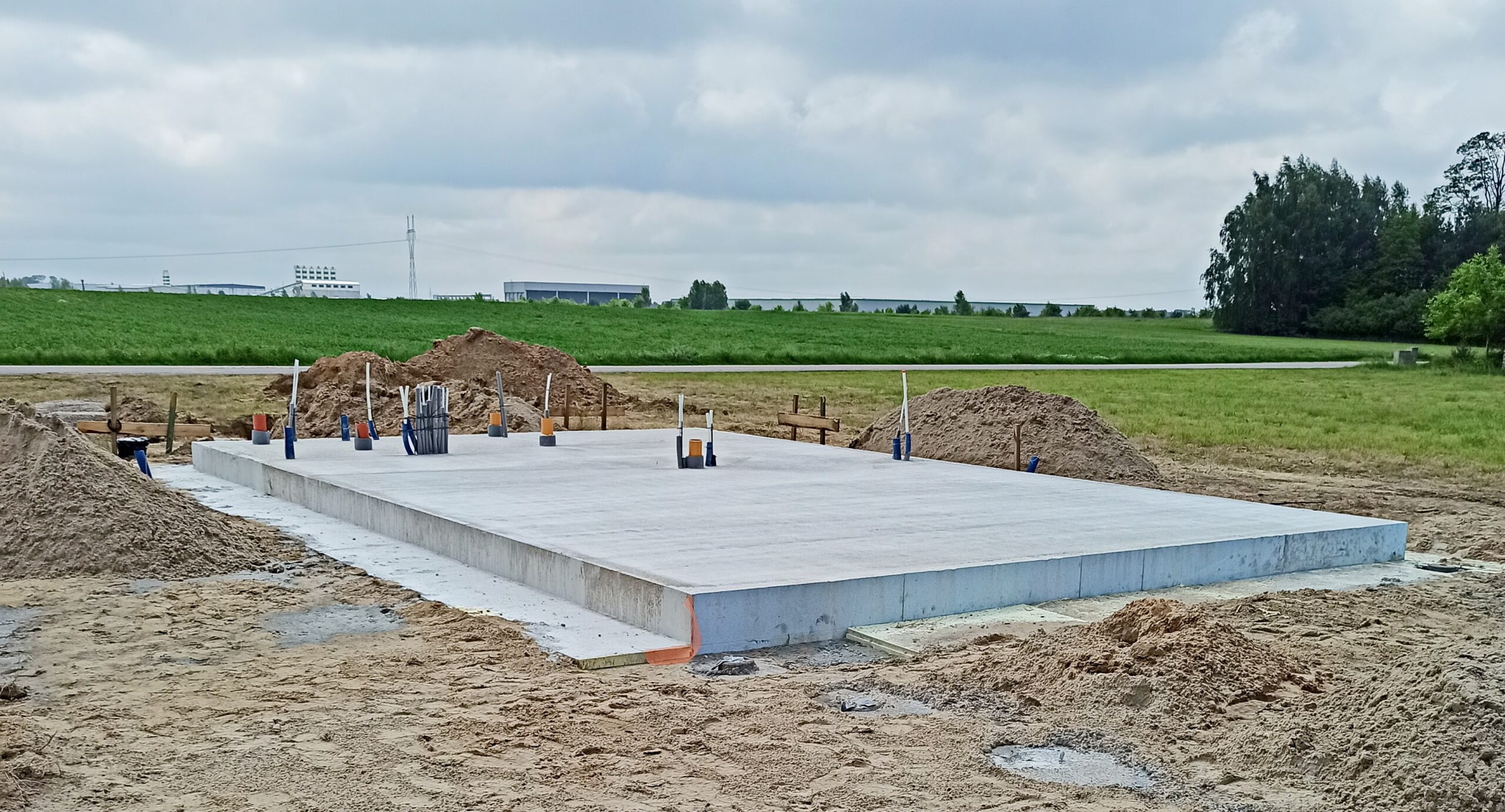
Foundation Slab vs. Traditional Footings – Which to Choose?
Investors often choose traditional foundations hoping they will be cheaper. It’s true that traditional footings require less material. Naturally, this translates to savings. However, a foundation slab requires insulation, reinforcement, and concrete across the entire surface, which involves higher material costs. But total cost calculations should also consider the time needed to complete the foundation and therefore the labor cost. A foundation slab can be completed much faster, reducing labor expenses. Although materials for footings are cheaper, the work is more labor-intensive, leading to higher labor costs.
A slab foundation of approx. 100 m² can be completed in 3–5 business days. In contrast, footings and foundation walls take 2–4 weeks, depending on weather and crew organization. Regardless of speed, open trenches pose a risk of flooding, which requires pumping out water and drying, both time-consuming and costly. A slab minimizes this risk by allowing excavation and backfilling in a single day.
In the long term, beyond comparing construction costs or pace, it’s essential to consider potential heat loss through the foundation. Slab foundations are insulated on the entire surface, unlike footings which are only insulated around the perimeter and filled with uninsulated lean concrete. For this reason, energy-efficient and passive houses are almost exclusively built on slab foundations.
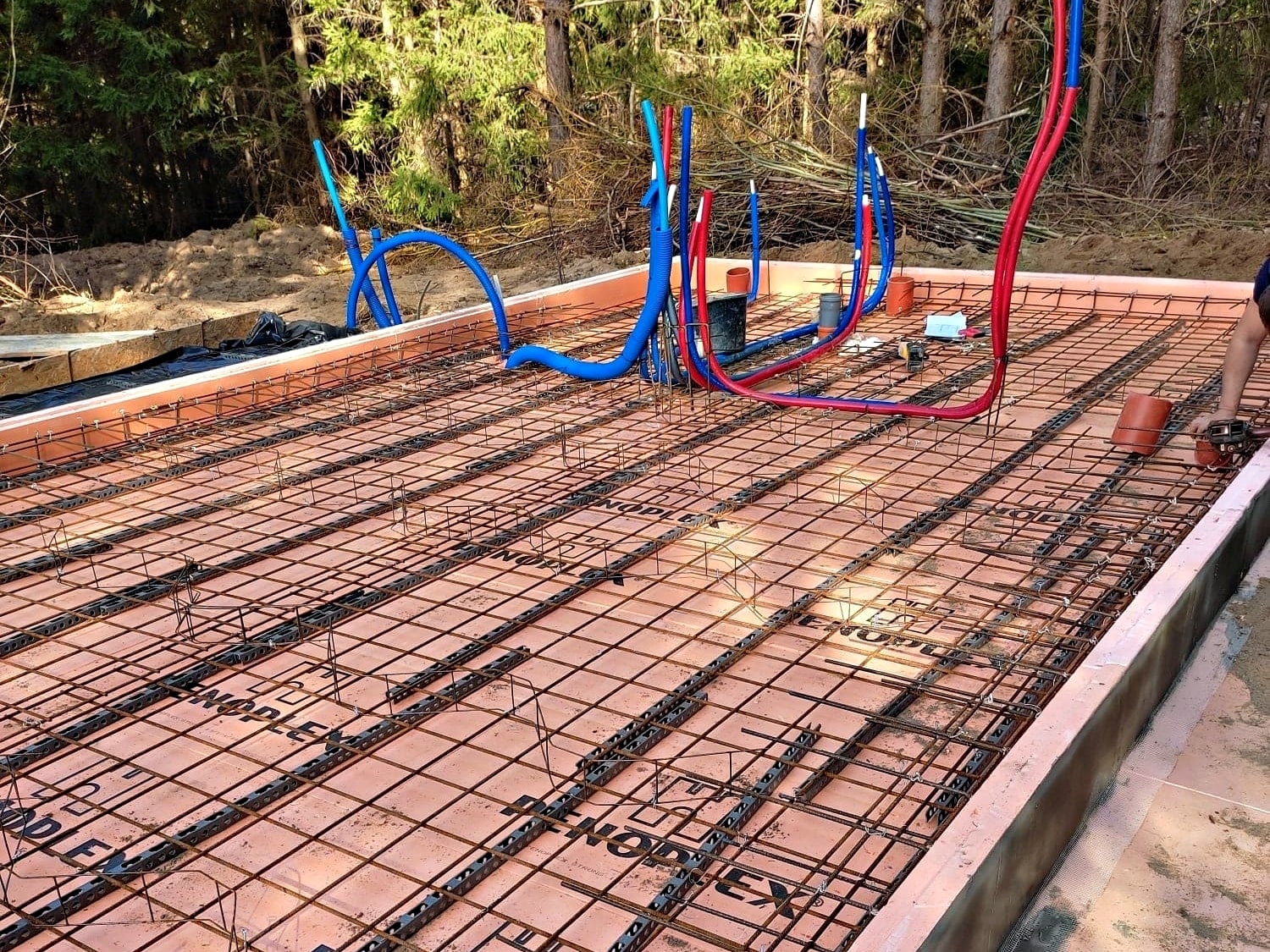

Further Features of the Foundation Slab
Slab foundations offer much more effective thermal insulation and can be built above the groundwater level. Traditional foundations must be placed below the frost line (approx. 80–140 cm in Poland). Slabs do not require such depth because they are fully insulated from the ground using XPS. It’s sufficient to remove the topsoil (30–50 cm) and replace it with non-frost-susceptible material (e.g., sand-gravel mix), then compact it. This reduces excavation work and helps in areas with high groundwater levels.
Concrete in a slab dries quickly—just 7–14 days—allowing house construction to begin. Traditional foundations dry for 21–28 days. Moreover, the slab evenly distributes building load across its surface. On weak soils, slabs are far superior, preventing uneven settlement and potential wall cracking. Radiant heating can be installed directly in the slab or integrated during pouring. These advantages accelerate construction, simplify coordination, and reduce overall costs.
When Should Traditional Footings Be Used?
Footings use less material, which saves money. But the process is more labor-intensive. If you have access to a low-cost construction crew—or plan to do the work yourself—footings might be more cost-effective. However, footings require thicker insulation later during the floor slab phase, which adds cost that’s not included in the footing estimate. In slabs, insulation is already included, possibly allowing for a thinner (or no) additional insulation layer.
What Does a Foundation Slab Cross-Section Look Like?
A professional slab design must be prepared by a licensed structural engineer, based on building parameters and soil conditions. In our projects, the slab surface is 20 cm below the final floor level. To enhance insulation and reduce thermal bridges, we apply additional insulation in the screed, which is 12 cm EPS + 6 cm concrete screed + 1.5–2 cm tile/panel.
Example standard slab cross-section (used in Modularen homes):
- Watertight concrete B25 W8, 200 mm thick
- Plumbing according to design
- Double steel mesh reinforcement, Ø8 mm bars
- Horizontal XPS insulation, 100 mm thick, 300 kPa
- Perimeter EPS Hydro insulation, 100 mm thick, 150 kPa
- Mechanically compacted sand-gravel mix, 200–300 mm
- Native soil

How to Begin Work on the Foundation Slab?
The next part of the article presents the general steps for slab construction. These are only guidelines; each slab must be designed based on individual ground conditions and building specs. Always consult your contractor and structural engineer.
1. Geotechnical Survey – Why Is It Necessary?
Before starting work, determine the soil type. If buying land, test the soil before purchasing. Soil composition affects earthwork scope and cost. Peat or clay may require soil replacement down to 1.5–2.0 m and advanced drainage. Sand is ideal and requires minimal replacement. Early testing can save tens of thousands of złoty.

2. Building Layout – How to Mark It?
Use the same surveyor who created the base map. They can also mark utility lines. The layout should use string line frameworks (wooden structures with pulled wire). Marking the outer edge of the slab, including insulation thickness, will ease future work. Avoid using wooden stakes alone—they will be removed during excavation.
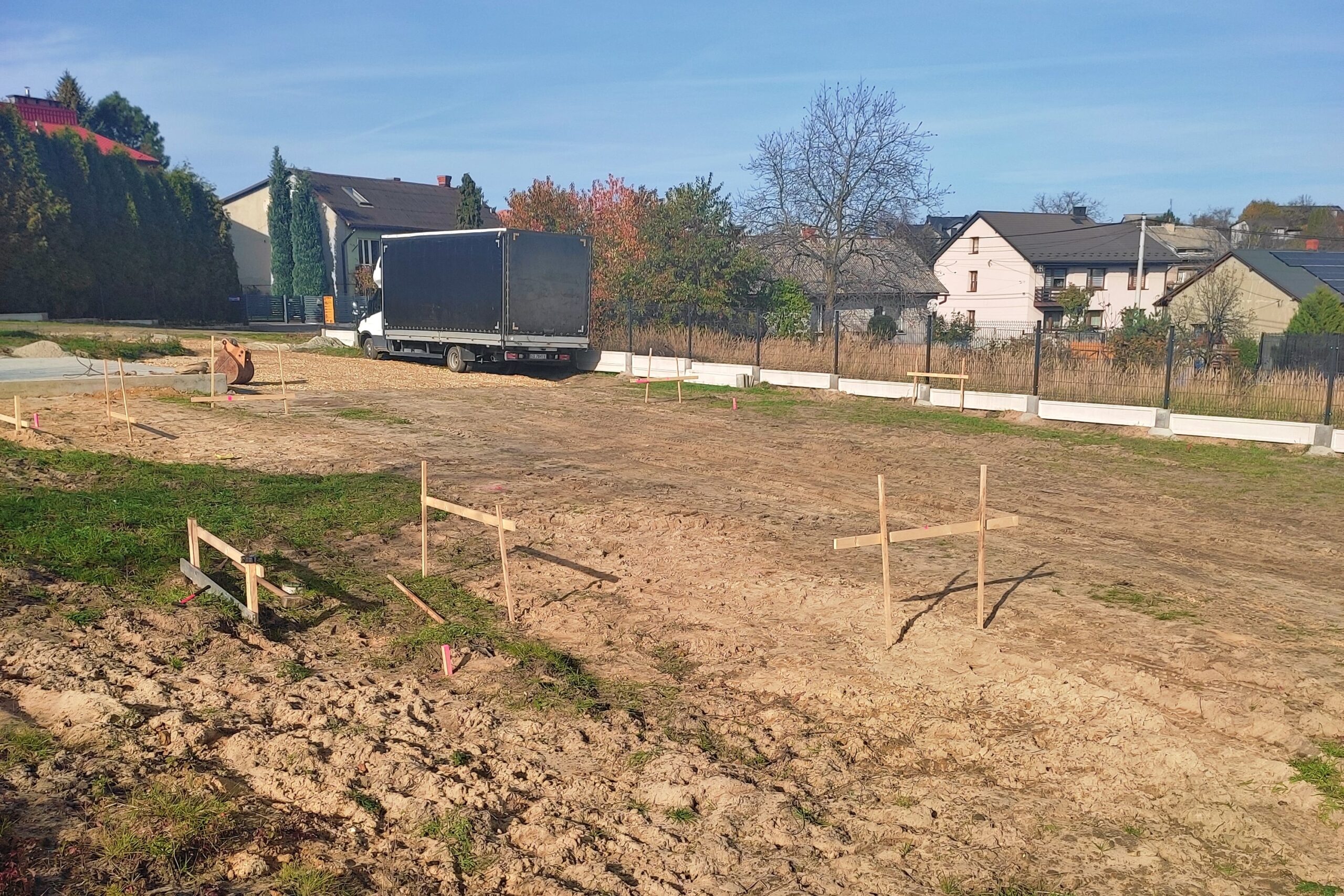
3. Soil Replacement – How to Prepare the Ground?
Remove topsoil (30–50 cm). If the subsoil is sand, you can proceed. If it’s clay or peat, deep replacement (up to 2 m) may be needed. This raises costs. For proper estimation and planning, a geotechnical survey is essential.
Assuming sand is found, bring in and compact sand-gravel mix using a plate compactor. If the slab level has not yet been set, determine it now. It should be 20–40 cm above ground level to protect against flooding and simplify landscaping.

4. Insulation from the Ground – How to Insulate the Slab?
Place perimeter formwork and insulation using prefabricated elements joined with metal connectors. Apply foam at joints. Install utility conduits according to design. Lay XPS insulation in two layers, offset, to prevent thermal bridging. Consult the engineer to select proper load-bearing XPS (e.g., 300 kPa).

5. Reinforcement – How to Install It Properly?
Follow the engineer’s drawings exactly, including reinforcement mesh density, bar diameter, stirrup placement, etc. Install double mesh separated with spacers. After this, install plumbing and possibly heating (if no screed will be added later). Pressure test the system.

6. Concreting the Slab – Key Considerations
Concrete thickness is dictated by the height of perimeter elements (e.g., 20 cm of B25 W8 concrete). Order concrete from a local plant. Distribute evenly, using a level, and compact with a vibrator to eliminate air pockets. After initial set, mechanically smooth the surface.

7. Concrete Screed for Terrace – Why and How to Build It?
If your house includes a wooden terrace, consider pouring a concrete base now. The process is similar but uses less material. One layer of reinforcement and 10 cm of concrete will suffice. Remember to provide a 1–2% slope for water runoff. A concrete base prevents weed growth and provides stability.

What Is the Cost of a Foundation Slab?
The final cost depends on:
- Terrain complexity
- Total area
- Slab shape
- Concrete volume
- Material assumptions (e.g., rebar diameter, insulation thickness)
For a detailed quote, complete the form and send your slab structural design. Our slabs are built by one trusted team across Poland. We offer full quality guarantees.
Request a quote for your foundation slab
Want a tailored offer?
Let us know your needs, and we’ll get back to you with a custom
info@modularen.com
PHONE
+ 48 535 602 351
+ 48 883 657 131
Address
Modularen Sp. z o.o. ul. Puławska 228/1 02-670 Warszawa