


What is infrared heating and how does it work?
Infrared heating involves the movement of electromagnetic waves through radiation. Infrared energy emits heat through the absorption of waves by living organisms or objects.
In practice, this means that waves are converted into heat upon contact with any surface. This process is independent of air, which ensures even heating throughout the room.
In contrast, traditional heating systems rely on air as the heat carrier, which naturally rises when warmed. With traditional radiators, the temperature between the floor and ceiling can differ by 5–10°C. This phenomenon does not occur with infrared radiation, as it emits waves evenly, which is why heating foils can also be installed in ceilings.
Infrared heating is typically provided by heating foils/mats. These foils are about 0.5 mm thick. The most important component is a fabric made of carbon fibers and carbon paste, which acts as the heating element.
The heat produced by the foil warms the floor, walls, and ceiling, which in turn emit heat into the room. In other words, the air is heated by the warmed objects.
Need a quote for a heating system for your investment?

Is infrared heating healthy?
Heating foils use so-called far infrared (FIR) radiation ranging from 25–1000 μm. FIR is generated due to electrical resistance in a material approximating a perfect black body. Such a material is pure carbon, used in the thin heating matrix printed onto the heating foil. This construction is entirely harmless to the human body. Moreover, FIR is even used in medicine.

Far infrared is also present in traditional tungsten light bulbs. Though now less common, we were all exposed to them for decades without any health effects. Infrared is also used in therapeutic chambers, saunas, and heating tunnels – all commonly found in modern SPA & Wellness centers. Infrared therapy is widely used in rehabilitation and muscle tissue regeneration, especially for athletes where speed and quality of recovery are critical.
Infrared rays penetrate the skin and reach subcutaneous tissue cells. Once there, they enhance lymphatic and blood circulation, supplying the body with nutrients and stimulating the immune system to fight diseases.
What are the average monthly costs of infrared heating?
The cost of infrared foil heating depends on the home’s insulation, window tightness, size, location, and electricity prices, which have recently been highly variable. It’s therefore difficult to provide an exact cost without specific guidelines.
As an example, take our prefab timber-frame house Prime House 54, with a footprint of 35 m² and a total area of 51 m². This house meets 2021 technical requirements, which mandate low thermal transmittance (U-values) for walls, roofs, windows, and doors. The lower the U-value, the lower the heat loss. Considering all these parameters, the average heating cost for year-round use during the heating season is about PLN 180–255/month.
As of November 2022, infrared foil manufacturers suggest assuming a cost of approx. PLN 3.5–5.0/m² of usable floor area. For a 120 m² building, this means an average monthly cost of PLN 420–600 during the heating season.
Ceiling or floor heating – how to choose?
In floor heating, this layer could be screed, tiles, boards, or panels. In ceiling heating, it would be the ceiling panel. In all cases, heat is emitted by the first material layer.
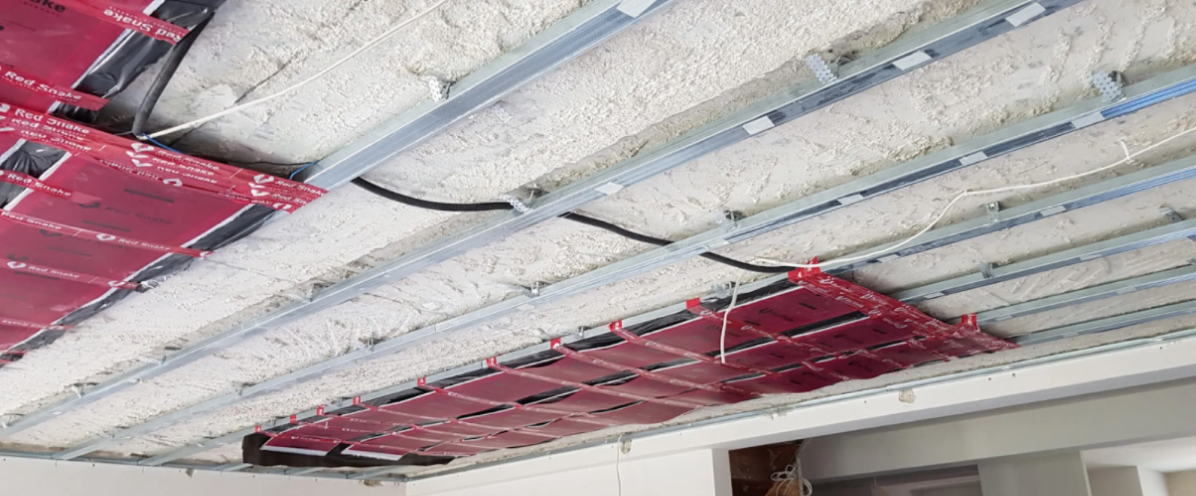
Therefore, floor heating is the default solution since heat naturally rises. Ceiling foils can be useful in small rooms with limited floor space (e.g., a small bedroom with a double bed) or in buildings where the floor is already finished. Installing ceiling foils and covering them with plasterboard is easier and cheaper than removing the entire floor.
When building a new house with normally sized rooms, floor heating is generally more efficient and comfortable, especially when using floor tiles. Nobody likes walking on a cold floor!
How to install infrared heating – foils or heating mats?
Infrared electric heating can be installed using either foils or heating mats.
- For floor panels, heating foils can be laid over the screed or on OSB/MFP boards (e.g., in attics). Panels are installed as floating floors, not glued down.
- For tiles, foils (made of PET plastic) cannot be directly tiled over. Instead, install the foil under the screed on insulation (e.g., polystyrene). This creates an accumulation system, allowing tiles to be laid on top.
- Always install a temperature sensor for each heating zone. Divide zones room by room and use separate thermostats for each.
If screed embedding is not possible, heating mats are the alternative. These are electric cables embedded in fiberglass mesh, laid in strips. Mats are suitable for tiled areas: bathrooms, hallways, kitchens, technical rooms, etc.
Mats are laid on screed or boards. Don’t forget the temperature sensor. You can then tile directly over them. Cable diameter: approx. 3 mm. Including tile and adhesive: leave about 20 mm for installation.
Mats are also thermostat-controlled, allowing zoned heating.

Advantages of infrared heating:
- Easy to install, maintenance-free, and reliable;
- Space-saving: only 0.5 mm thick, hidden in floor/ceiling/walls;
- High thermal output = rapid surface heating;
- Uniform heat distribution;
- Remote control via Wi-Fi apps – great for rental or occasional use;
- Low installation and operating costs vs. traditional heating or heat pumps;
- No air movement – less dust = ideal for allergy or asthma sufferers;
- Eco-friendly, especially when combined with photovoltaics;
- Warm walls reduce moisture and mold risk.
Disadvantages of infrared heating:
- Infrared foils do not heat water – separate water heater needed;
- In poorly insulated older buildings, power demand and costs rise;
- Installation in existing buildings may require floor removal and electrical adjustments;
- Electricity price volatility affects operating costs.
Koszt instalacji folii na podczerwień
To receive a detailed cost estimate for materials and installation, please fill out the form below. With full building specifications, we can provide an accurate quote.
Heating foils/mats in our homes are supplied and installed by a trusted partner, ensuring quality and full warranty. If you wish to work with our specialists, we offer installation services throughout Poland.
Get a Heating Quote
Looking for a tailored offer? Tell us what you’re interested in, and we’ll respond with a personalized solution.
info@modularen.com
Phone
+ 48 535 602 351
+ 48 883 657 131
Address
Modularen Sp. z o.o. ul. Puławska 228/1 02-670 Warszawa