


Grand House 190
Prefabricated single-story house
with a garage with a usable area of 190 m²
Grand House 190
Prefabricated Single-Storey House with a garage
Grand House 190 is a single-storey house with a double garage in the style of a modern barn, designed for a family of 4–6.
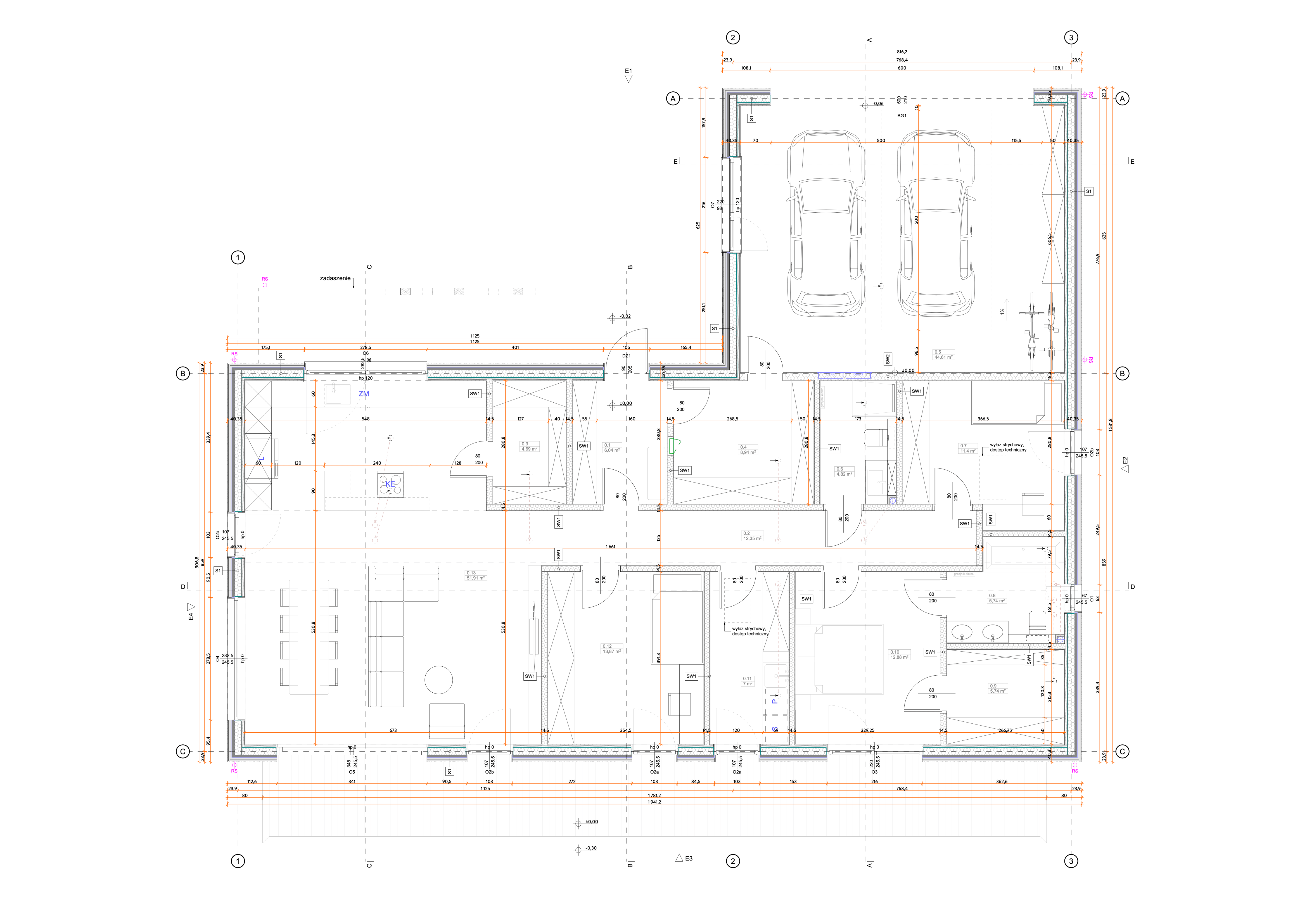
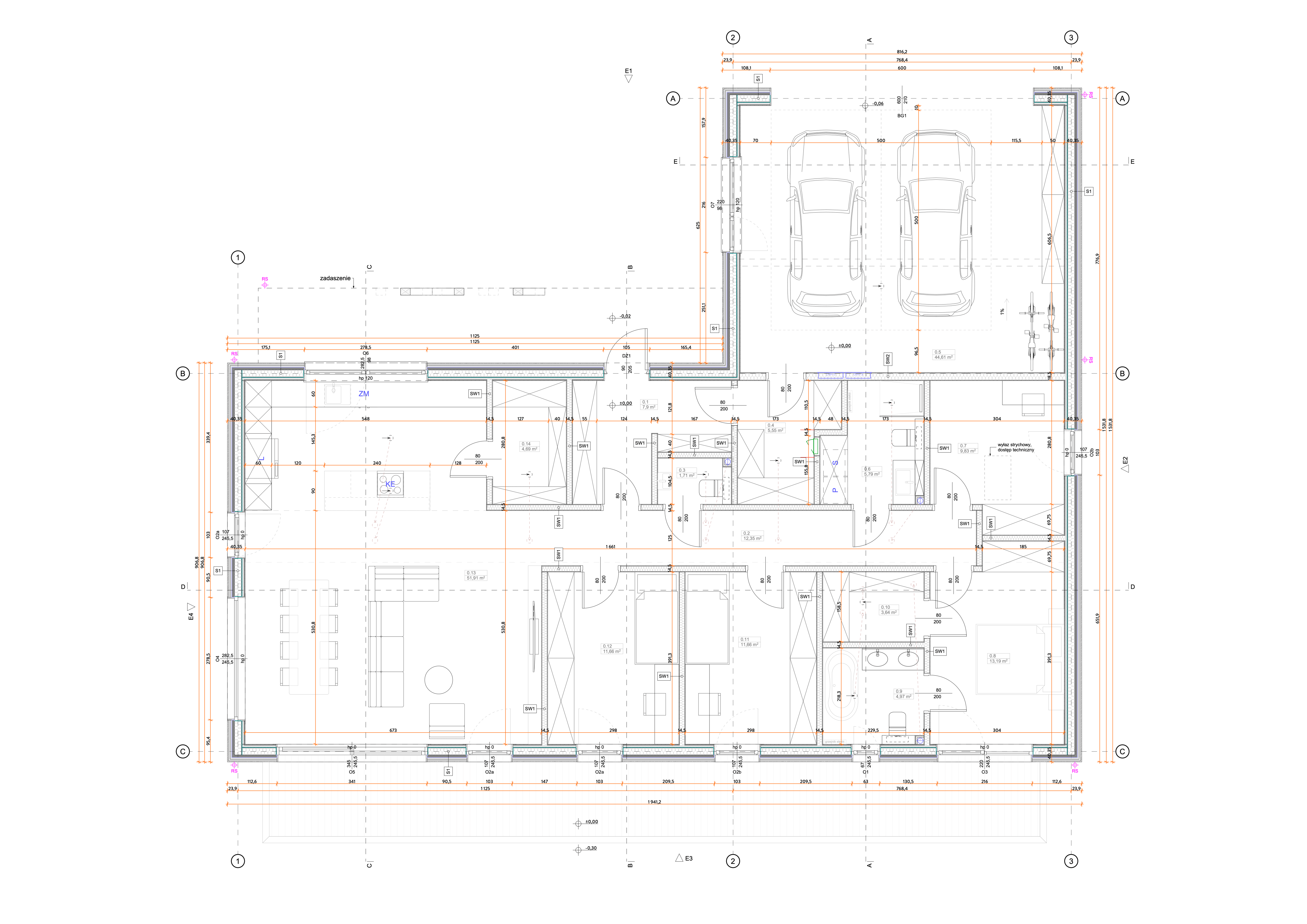
The layout includes a spacious living room with an open-plan kitchen of 52 m², three or four well-proportioned rooms, two large bathrooms, a sizeable kitchen with pantry, a roomy technical/utility room, a comfortable laundry room, a highly functional vestibule, and a walk-in wardrobe.
In addition, we have designed a double garage as an integral part of the building.
Storage spaces, often overlooked in other designs, have been made a priority here. The house features a spacious vestibule with a built-in wardrobe niche, a large technical room for storing items and housing technical equipment, a pantry next to the kitchen, a large laundry room, and a functional walk-in wardrobe.
The building meets the technical standards in accordance with the WT2021 regulation. It is a year-round, energy-efficient home whose insulation parameters come very close to the passive house standard. It meets all requirements for construction with a full building permit.
With the use of modern ventilation, heating, cooling, and renewable energy systems, the building can be constructed to meet the zero-energy standard, where the balance between energy produced and consumed equals zero.
Purpose
Our prefabricated single-storey house with a double garage is an excellent choice as a permanent residence for a family of 4–6. The house is divided into a sleeping area on one side of the building and a living area on the other. This functional layout offers residents comfortable living conditions while allowing them to enjoy beautiful views through large patio windows.
Specifications
- Usable floor area:
- Building footprint:
- Building height:
- Ground floor height:
- External dimensions:
- 190 m²
- 227 m²
- 6,05 m
- 2,70 m
- 15,32 x 19,41 m
Functional Living Space
The home provides everything needed for year-round living – a spacious kitchen with living room, three or four bedrooms, two bathrooms, a walk-in wardrobe, pantry, laundry room, vestibule, technical room, and an integrated garage.
Our double garage design is much more than just a place to park cars – it’s a well-planned space, ideal for storing tools, bicycles, or garden equipment. Direct access from the garage to the main building ensures convenience in everyday use, regardless of the weather. This is a practical solution that harmoniously combines functionality with a modern approach to organising the space around the home.
The technical room allows for the installation of larger sanitary systems, such as water treatment units, pressure booster sets, water heaters, or heat pumps.
The spacious living room with kitchen on the ground floor is the heart of family life and the place for gatherings with friends and loved ones. Its functional design offers plenty of space for the whole family to spend time together. With the fireplace planned in the living room, we believe that the warmth of the home will take on an even deeper meaning.
The non-habitable attic provides additional storage space not included in the building’s floor area – ideal for large, seasonal items.
Top-Quality Materials
The facade of our house is finished with spruce cladding. The roof is covered with modular metal roofing tiles. The window joinery includes six-chamber, triple-glazed windows, installed using the warm installation method.
The main insulation of the house consists of mineral wool or, optionally, Steico Zell blown-in wood fibre. The house is additionally insulated with Steico thermal insulation boards.
Floor Plans & Interior Visualizations
See the layout of our modern barn-style home.
For more detailed architectural materials, we encourage you to get in touch directly.
Interior Finish Options
Our prefabricated timber frame house design is available in three finishing options:
Closed Shell Stage
(net + 8% VAT)
- Wall structure without installation cavity (22 cm insulation)
- Roof, floor, and internal walls without boarding
- Spruce facade
- Roofing installation
- Window joinery
Developer Stage
(net + 8% VAT)
Includes Closed Shell Stage, plus:
- Installation cavity with an additional 5 cm insulation (total 27 cm wall insulation)
- Ceiling closure and 35–40 cm ceiling insulation
- Electrical and plumbing installation
- Heating system with mobile app control
- Fermacell boards on walls, plasterboard on ceilings
- Cement screeds
- Attic ladder
Turnkey Finish
(net + 8% VAT)
Includes Developer Stage, plus:
- Wall and ceiling finishes
- Bathroom fit-out
- Floor and door installation
- Lighting installation
- Kitchen installation
Download Full Offer
Stay in touch and download the complete catalog containing all of our house designs along with detailed pricing.
Premium Standard Wall System
Discover our heavy timber prefabricated wall system
Exterior Wall with Timber Cladding [40 cm]
- Scandinavian spruce cladding, tongue and groove
- Battens and counter-battens
- Tyvek Housewrap windproof membrane
- Steico / Naturheld wood fibre insulation board
- C24 KVH finger-jointed structural timber
- Mineral wool insulation
- MFP P5 structural stiffening board
- Steico Multi Membra 5 vapour barrier membrane
- Service cavity
- Mineral wool insulation
- Fire-resistant, moisture-resistant Fermacell board
[mm]
22
38 x 58 x 2
–
60
60 x 160
160
12
–
60 x 60
50
12,5

Robust structure built using German heavy timber frame technology
We build our walls using certified KVH structural timber, finger-jointed and glued, with a cross-section of 60 x 160 mm. This timber contains 47% more raw material than standard Scandinavian beams with a 45 x 145 mm cross-section. The more massive wall structure significantly improves the building’s statics and the mechanical performance of structural joints.
Additionally, instead of standard gypsum plasterboard, we use Fermacell gypsum fibre boards as the interior wall finish. Fermacell boards are twice as dense and therefore significantly harder than standard plasterboard, which greatly improves the building’s structural performance and fire resistance. These boards are also moisture-resistant, making them suitable for wet areas.
Our German heavy frame construction system, combined with double wall stiffening using Fermacell and MFP P5 boards, ensures that our buildings meet the requirements of Poland’s highest wind and snow load zones as standard.
Vapour-open construction in accordance with building physics
The walls and roofs of our houses are additionally insulated with 6.0 cm thick Steico insulation boards. This results in a total wall insulation thickness of 27.0 cm [Uw = 0.135 W/m²K] and roof insulation of 30.0 cm [Uw = 0.126 W/m²K]. These boards significantly improve the thermal transmittance coefficient (Uw) of the building envelope and, due to their high specific heat capacity (Cw), also protect against overheating in summer. Additionally, they enhance acoustic insulation.
As a result, our homes qualify as premium in terms of both energy efficiency and soundproofing. Wood fibre boards are vapour-open materials that can be installed on the exterior side of the structure. Unlike polystyrene or OSB boards, which block moisture escape when placed on the exterior, wood fibre boards allow for proper moisture diffusion, significantly extending the life of the structure and preventing mould and mildew growth.
Installation Cavity for Electrical and Plumbing Systems
The installation battening we use on the interior side of the walls serves as a dedicated space for mounting electrical boxes, running cables in conduits, and concealing water pipes. This additional installation cavity is designed to protect the vapour barrier from being punctured.
Failing to use an installation cavity—and instead embedding installations directly into the main wall structure—leads to puncturing the vapour barrier. This allows water vapour to penetrate the structure and the main insulation layer, ultimately degrading the wall system and contributing to mould and mildew growth within the building.
The installation cavity eliminates this issue by preserving the continuity and airtightness of the vapour barrier, as all utilities are placed within the secondary battening layer. This cavity also provides an additional 5 cm layer of insulation.
Thanks to this wall system design and the high quality of materials we use, we confidently offer a 30-year warranty on the structural integrity of our homes.
Premium Standard Wall System
Discover our heavy timber prefabricated wall system
- Scandinavian spruce cladding, tongue and groove
- Battens and counter-battens
- Tyvek Housewrap windproof membrane
- Steico / Naturheld wood fibre insulation board
- C24 KVH finger-jointed structural timber
- Mineral wool insulation
- MFP P5 structural stiffening board
- Steico Multi Membra 5 vapour barrier membrane
- Service cavity
- Mineral wool insulation
- Fire-resistant, moisture-resistant Fermacell board
22
38 x 58 x 2
–
60
60 x 160
160
12
–
60 x 60
50
12,5
Exterior Wall with Timber Cladding [40 cm]
Robust structure built using German heavy timber frame technology
We build our walls using certified KVH structural timber, finger-jointed and glued, with a cross-section of 60 x 160 mm. This timber contains 47% more raw material than standard Scandinavian beams with a 45 x 145 mm cross-section. The more massive wall structure significantly improves the building’s statics and the mechanical performance of structural joints.
Additionally, instead of standard gypsum plasterboard, we use Fermacell gypsum fibre boards as the interior wall finish. Fermacell boards are twice as dense and therefore significantly harder than standard plasterboard, which greatly improves the building’s structural performance and fire resistance. These boards are also moisture-resistant, making them suitable for wet areas.
Our German heavy frame construction system, combined with double wall stiffening using Fermacell and MFP P5 boards, ensures that our buildings meet the requirements of Poland’s highest wind and snow load zones as standard.
Vapour-open construction in accordance with building physics
The walls and roofs of our houses are additionally insulated with 6.0 cm thick Steico insulation boards. This results in a total wall insulation thickness of 27.0 cm [Uw = 0.135 W/m²K] and roof insulation of 30.0 cm [Uw = 0.126 W/m²K]. These boards significantly improve the thermal transmittance coefficient (Uw) of the building envelope and, due to their high specific heat capacity (Cw), also protect against overheating in summer. Additionally, they enhance acoustic insulation.
As a result, our homes qualify as premium in terms of both energy efficiency and soundproofing. Wood fibre boards are vapour-open materials that can be installed on the exterior side of the structure. Unlike polystyrene or OSB boards, which block moisture escape when placed on the exterior, wood fibre boards allow for proper moisture diffusion, significantly extending the life of the structure and preventing mould and mildew growth.
Installation Cavity for Electrical and Plumbing Systems
The installation battening we use on the interior side of the walls serves as a dedicated space for mounting electrical boxes, running cables in conduits, and concealing water pipes. This additional installation cavity is designed to protect the vapour barrier from being punctured.
Failing to use an installation cavity—and instead embedding installations directly into the main wall structure—leads to puncturing the vapour barrier. This allows water vapour to penetrate the structure and the main insulation layer, ultimately degrading the wall system and contributing to mould and mildew growth within the building.
The installation cavity eliminates this issue by preserving the continuity and airtightness of the vapour barrier, as all utilities are placed within the secondary battening layer. This cavity also provides an additional 5 cm layer of insulation.
Thanks to this wall system design and the high quality of materials we use, we confidently offer a 30-year warranty on the structural integrity of our homes.