


Prefabricated Timber
Frame Houses
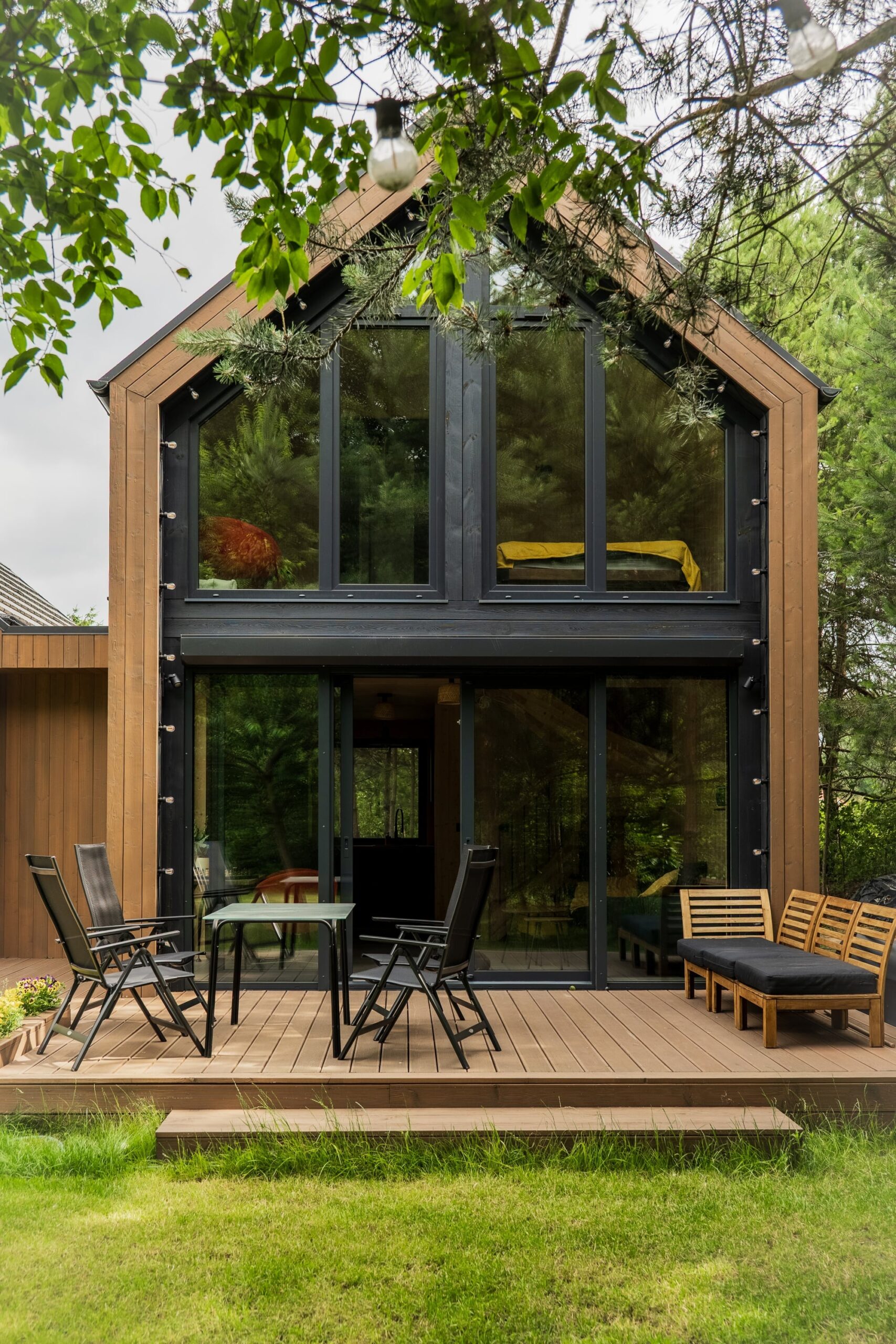
We build prefabricated timber frame houses — from the design phase, through groundwork and construction, all the way to full project completion.
We build prefabricated timber frame houses. Built to last.
The aesthetic value of the prefabricated timber frame houses we build is very important to us. However, we place durability and quality of our buildings above all else. For this reason, we construct our houses using high-quality building materials tested in Western Europe.
We advise on the best material and architectural solutions for your home, with special attention to the building’s placement on your plot, its surroundings, soil conditions, and formal or legal requirements. Only after our design team has analyzed the documents do we proceed with the process of obtaining a building permit or filing a construction notice.
Groundwork, house production, on-site assembly, and all follow-up construction tasks on the final plot are carried out comprehensively by our team. We supervise every stage of construction, lifting the burden of planning and quality control from the Investor’s shoulders.
We believe we have an impact on our surroundings and the environment we live in. We also believe that a home is one of the most important parts of our life’s journey. If you share these values, we invite you to embark on this journey with us.
Timber Frame House Designs
Check out our energy-efficient, prefabricated timber frame homes
Grand House 190
SINGLE-STORY HOUSE WITH GARAGE
Grand House 145
SINGLE-STOREY HOUSE
Grand House 115
SINGLE-STOREY HOUSE
Grand House 103
SINGLE-STOREY HOUSE
Grand House 90
SINGLE-STOREY HOUSE
Grand House 78
SINGLE-STOREY HOUSE
Grand House 59
SINGLE-STOREY HOUSE
Prime House 110
HOUSE WITH USABLE ATTIC
Prime House 83
HOUSE WITH USABLE ATTIC
Prime House 54
DOM Z PODDASZEM UŻYTKOWYM
Rest House 88
HOUSE WITH MEZZANINE
Rest House 66
HOUSE WITH MEZZANINE
Rest House 45
DOM Z ANTRESOLĄ
Premium Standard Wall System
Discover our heavy timber prefabricated wall system
Exterior Wall with Timber Cladding [40 cm]
- Scandinavian spruce cladding, tongue and groove
- Battens and counter-battens
- Tyvek Housewrap windproof membrane
- Steico / Naturheld wood fibre insulation board
- C24 KVH finger-jointed structural timber
- Mineral wool insulation
- MFP P5 structural stiffening board
- Steico Multi Membra 5 vapour barrier membrane
- Service cavity
- Mineral wool insulation
- Fire-resistant, moisture-resistant Fermacell board
[mm]
22
38 x 58 x 2
–
60
60 x 160
160
12
–
60 x 60
50
12,5

Robust structure built using German heavy timber frame technology
We build our walls using certified KVH structural timber, finger-jointed and glued, with a cross-section of 60 x 160 mm. This timber contains 47% more raw material than standard Scandinavian beams with a 45 x 145 mm cross-section. The more massive wall structure significantly improves the building’s statics and the mechanical performance of structural joints.
Additionally, instead of standard gypsum plasterboard, we use Fermacell gypsum fibre boards as the interior wall finish. Fermacell boards are twice as dense and therefore significantly harder than standard plasterboard, which greatly improves the building’s structural performance and fire resistance. These boards are also moisture-resistant, making them suitable for wet areas.
Our German heavy frame construction system, combined with double wall stiffening using Fermacell and MFP P5 boards, ensures that our buildings meet the requirements of Poland’s highest wind and snow load zones as standard.
Vapour-open construction in accordance with building physics
The walls and roofs of our houses are additionally insulated with 6.0 cm thick Steico insulation boards. This results in a total wall insulation thickness of 27.0 cm [Uw = 0.135 W/m²K] and roof insulation of 30.0 cm [Uw = 0.126 W/m²K]. These boards significantly improve the thermal transmittance coefficient (Uw) of the building envelope and, due to their high specific heat capacity (Cw), also protect against overheating in summer. Additionally, they enhance acoustic insulation.
As a result, our homes qualify as premium in terms of both energy efficiency and soundproofing. Wood fibre boards are vapour-open materials that can be installed on the exterior side of the structure. Unlike polystyrene or OSB boards, which block moisture escape when placed on the exterior, wood fibre boards allow for proper moisture diffusion, significantly extending the life of the structure and preventing mould and mildew growth.
Installation Cavity for Electrical and Plumbing Systems
The installation battening we use on the interior side of the walls serves as a dedicated space for mounting electrical boxes, running cables in conduits, and concealing water pipes. This additional installation cavity is designed to protect the vapour barrier from being punctured.
Failing to use an installation cavity—and instead embedding installations directly into the main wall structure—leads to puncturing the vapour barrier. This allows water vapour to penetrate the structure and the main insulation layer, ultimately degrading the wall system and contributing to mould and mildew growth within the building.
The installation cavity eliminates this issue by preserving the continuity and airtightness of the vapour barrier, as all utilities are placed within the secondary battening layer. This cavity also provides an additional 5 cm layer of insulation.
Thanks to this wall system design and the high quality of materials we use, we confidently offer a 30-year warranty on the structural integrity of our homes.
Premium Standard Wall System
Discover our heavy timber prefabricated wall system
- Scandinavian spruce cladding, tongue and groove
- Battens and counter-battens
- Tyvek Housewrap windproof membrane
- Steico / Naturheld wood fibre insulation board
- C24 KVH finger-jointed structural timber
- Mineral wool insulation
- MFP P5 structural stiffening board
- Steico Multi Membra 5 vapour barrier membrane
- Service cavity
- Mineral wool insulation
- Fire-resistant, moisture-resistant Fermacell board
22
38 x 58 x 2
–
60
60 x 160
160
12
–
60 x 60
50
12,5
Exterior Wall with Timber Cladding [40 cm]
Robust structure built using German heavy timber frame technology
We build our walls using certified KVH structural timber, finger-jointed and glued, with a cross-section of 60 x 160 mm. This timber contains 47% more raw material than standard Scandinavian beams with a 45 x 145 mm cross-section. The more massive wall structure significantly improves the building’s statics and the mechanical performance of structural joints.
Additionally, instead of standard gypsum plasterboard, we use Fermacell gypsum fibre boards as the interior wall finish. Fermacell boards are twice as dense and therefore significantly harder than standard plasterboard, which greatly improves the building’s structural performance and fire resistance. These boards are also moisture-resistant, making them suitable for wet areas.
Our German heavy frame construction system, combined with double wall stiffening using Fermacell and MFP P5 boards, ensures that our buildings meet the requirements of Poland’s highest wind and snow load zones as standard.
Vapour-open construction in accordance with building physics
The walls and roofs of our houses are additionally insulated with 6.0 cm thick Steico insulation boards. This results in a total wall insulation thickness of 27.0 cm [Uw = 0.135 W/m²K] and roof insulation of 30.0 cm [Uw = 0.126 W/m²K]. These boards significantly improve the thermal transmittance coefficient (Uw) of the building envelope and, due to their high specific heat capacity (Cw), also protect against overheating in summer. Additionally, they enhance acoustic insulation.
As a result, our homes qualify as premium in terms of both energy efficiency and soundproofing. Wood fibre boards are vapour-open materials that can be installed on the exterior side of the structure. Unlike polystyrene or OSB boards, which block moisture escape when placed on the exterior, wood fibre boards allow for proper moisture diffusion, significantly extending the life of the structure and preventing mould and mildew growth.
Installation Cavity for Electrical and Plumbing Systems
The installation battening we use on the interior side of the walls serves as a dedicated space for mounting electrical boxes, running cables in conduits, and concealing water pipes. This additional installation cavity is designed to protect the vapour barrier from being punctured.
Failing to use an installation cavity—and instead embedding installations directly into the main wall structure—leads to puncturing the vapour barrier. This allows water vapour to penetrate the structure and the main insulation layer, ultimately degrading the wall system and contributing to mould and mildew growth within the building.
The installation cavity eliminates this issue by preserving the continuity and airtightness of the vapour barrier, as all utilities are placed within the secondary battening layer. This cavity also provides an additional 5 cm layer of insulation.
Thanks to this wall system design and the high quality of materials we use, we confidently offer a 30-year warranty on the structural integrity of our homes.
Completed Prefabricated Timber Frame Homes
Our Selected Energy-Efficient House Projects
Contact Us
Would you like to receive a more detailed offer? Tell us what you’re looking for, and we’ll get back to you with a solution tailored to your needs.
info@modularen.com
+ 48 535 602 351
+48 536 838 863
Address
Modularen Sp. z o.o.
ul. Aleja Niepodległości 124/23
02-577Warszawa



